setState组件更新和hooks的初始化
前言
setState()函数在任何情况下都会导致组件重渲染吗?如果setState中的state没有发生改变呢?
比对是依赖项是否一致的时候,用的是Object.is:
Object.is() 与 === 不相同。差别是它们对待有符号的零和 NaN 不同,例如,=== 运算符(也包括 == 运算符)将数字 -0 和 +0 视为相等,而将 Number.NaN 与 NaN 视为不相等。
例5-主要测试实5-没有导致state的值发生变化的setState是否会导致重渲染.html
没有导致state的值发生变化的this.setState()是否会导致重渲染-->不会
如果state和从父组件传过来的props都没变化,那子组件就一定不会发生重渲染吗?
对象和数组注意点
- 数组是引用,更新了数组,但是数组的引用地址没有变化,react就不会认为它有变化
- 对象是引用,没有被重新赋值(地址没有改变),不更新视图。
子组件更新的条件是其 props 或 state 发生变化。如果父组件重新渲染时,传递给子组件的 props 没有发生变化,那么子组件不会更新。
React采用了基于值比较的浅比较(shallow comparison)策略,只有当props和state的引用发生变化时,React才会重新渲染组件。但如果props和state是复杂对象(如数组和对象),浅比较将只比较它们的引用,而不是它们的内容。如果父组件每次重新渲染时都会创建新的props对象,子组件也会被重新渲染,即使props的值没有改变。
通过 Object.is() 进行比较,这是一种严格相等比较,比浅比较更加严格。具体来说,Object.is() 会比较两个值的类型和值,而浅比较只会比较引用是否相同。
需要注意的是,如果 props 中包含对象或数组等引用类型的值,即使它们的内容没有发生变化,只要引用发生了变化,React 仍然会认为 props 发生了变化,因此会重新渲染组件。这是因为在 JavaScript 中,对象和数组是引用类型,其值在比较时是按照引用地址进行比较的。
当父组件更新,props没改变,sub组件不会更新
当父组件更新,props 引用地址改变,如上面的例子
setObj,sub组件会更新
会渲染的场景:
- 比如传递方法
<Sub obj={obj} changeSubData={changeSubData} />,方法每次都会生成新的,尽管props没变,但是方法每次都是新的会触发渲染 - 每次都生成新的props,尽管值没改变,但是子组件依然会重新渲染
- 子组件的渲染函数不是一个纯函数。如果子组件的渲染函数中包含了对于外部变量的依赖,那么当外部变量改变时,子组件也会随之发生变化,即使prop没有改变。
- 子组件使用了非受控组件或是使用了ref。非受控组件和ref的变化不会被React所感知,这会导致子组件的重新渲染,即使prop的值没有改变。
要解决的唯一途径是使用shouldComponentUpdate/memo
api-memo和shouldComponentUpdate
重要的全局变量
currentlyRenderingFiber:正在处理的函数组件对应 fiber。在执行 useState 等 hook 时,需要通过它知道当前 hook 对应哪个 fiber。
workInProgressHook:挂载时正在处理的 hook 对象。我们会沿着 workInProcess.memoizedState 链表一个个往下走,这个 workInProgressHook 就是该链表的指针。
currentHook:旧的 fiber 的 hooks 链表(current.memorizedState)指针。
ReactCurrentDispatcher:全局对象,是一个 hook 调度器对象,其下有 useState、useEffect 等方法,是我们业务代码中 hook 底层调用的方法。ReactCurrentDispatcher 有三种:
ContextOnlyDispatcher:所有方法都会抛出错误,用于防止开发者在调用函数组件的其他时机调用 React Hook;

HooksDispatcherOnMount:挂载阶段用。比如它的 useState 要将初始值保存起来;

HooksDispatcherOnUpdate:更新阶段用。比如它的 useState 会无视传入的初始值,而是从链表中取出值。
复习渲染流程
编译前
  console.log('=Babel:', Babel)
  function Test() {
    console.log('test-render')
    const [data, setData] = React.useState('改变我')
    const [showDiv, setShowDiv] = React.useState(false)

    const onClickText = () => {
      console.log('=useState=onClick');
      setData('努力哦')
      setShowDiv(!showDiv)
    }

    const onClickText2 = () => {
      console.log('=useState=onClick:', data);
    }

    React.useEffect(() => {
      console.log('=副作用-useEffect-->运行');
    }, [])

    React.useLayoutEffect(() => {
      console.log('=副作用-useLayoutEffect-->运行');
    }, [])

    return (
      <div id='div1' className='c1'>
        <button onClick={onClickText} className="btn">Hello world,Click me</button>
        <span>{data}</span>
        {showDiv && <div>被你发现了</div>}
        <div id='div2' className='c2'>
          <p>测试子节点</p>
        </div>
      </div>
    )
  }

  const root = ReactDOM.createRoot(document.getElementById('root'))
  console.log("=app=root:", root)
  root.render(<Test />);
  // 17 写法
  // ReactDOM.render(<Test />, document.getElementById('root'))
编译后的code
关注编译后的hooks:useState
function Test() {
  console.log('test-render');

  var _React$useState = React.useState('改变我'),
      _React$useState2 = _slicedToArray(_React$useState, 2),
      data = _React$useState2[0],
      setData = _React$useState2[1];

  var _React$useState3 = React.useState(false),
      _React$useState4 = _slicedToArray(_React$useState3, 2),
      showDiv = _React$useState4[0],
      setShowDiv = _React$useState4[1];

  var onClickText = function onClickText() {
    console.log('=useState=onClick');
    setData('努力哦');
    setShowDiv(!showDiv);
  };

  var onClickText2 = function onClickText2() {
    console.log('=useState=onClick:', data);
  };

  React.useEffect(function () {
    console.log('=副作用-useEffect-->运行');
  }, []);

  React.useLayoutEffect(function () {
    console.log('=副作用-useLayoutEffect-->运行');
  }, []);

  return React.createElement(
    'div',
    { id: 'div1', className: 'c1' },
    React.createElement(
      'button',
      { onClick: onClickText, className: 'btn' },
      'Hello world,Click me'
    ),
    React.createElement(
      'span',
      null,
      data
    ),
    showDiv && React.createElement(
      'div',
      null,
      '\u88AB\u4F60\u53D1\u73B0\u4E86'
    ),
    React.createElement(
      'div',
      { id: 'div2', className: 'c2' },
      React.createElement(
        'p',
        null,
        '\u6D4B\u8BD5\u5B50\u8282\u70B9'
      )
    )
  );
}
流程图-初始化hook-state-接上面beginWork
useState挂载hooks函数;生成dispatch
初始化/更新阶段挂载的hooks
- workInProgress 赋值给全局变量 currentlyRenderingFiber,之后执行 hook 就能知道是给哪个组件更新状态了
- 选择 hook 调度器:根据是挂载还是更新阶段,ReactCurrentDispatcher 设置为对应 hook 调度器
- 调用函数组件,进行 render。函数组件内部会调用 Hook
- 重置全局变量,比如 currentlyRenderingFiber 设置回 null;ReactCurrentDispatcher 还原为 ContextOnlyDispatcher,防止在错误时机使用 Hook。
renderWithHooks 中,我们会根据组件处于不同的状态,给 ReactCurrentDispatcher.current 挂载不同的 dispatcher 。而在first paint 时,挂载的是ContextOnlyDispatcher 或则 HooksDispatcherOnMountInDEV
function renderWithHooks(current, workInProgress, Component, props, secondArg, nextRenderLanes) {
  renderLanes = nextRenderLanes;
  currentlyRenderingFiber$1 = workInProgress;
  // 省略
  debugger
  // 2. 根据是挂载还是更新阶段,选择对应 hook 调度器
  {
    if (current !== null && current.memoizedState !== null) {
      // 更新阶段
      ReactCurrentDispatcher$1.current = HooksDispatcherOnUpdateInDEV;
    } else if (hookTypesDev !== null) {
      ReactCurrentDispatcher$1.current = HooksDispatcherOnMountWithHookTypesInDEV;
    } else {
      // 初始化
      ReactCurrentDispatcher$1.current = HooksDispatcherOnMountInDEV;
    }
  }

  // 3. 调用函数组件,里面执行各种 React Hook,并返回 ReactElement
  var children = Component(props, secondArg); // Check if there was a render phase update

  // 省略

  // 4. hook 调度器还原为 ContextOnlyDispatcher
  console.log(`%c=探究初始和hook=renderWithHooks挂载,调度器还原为 ContextOnlyDispatcher`, 'color:blueviolet', { current: ContextOnlyDispatcher })
  ReactCurrentDispatcher$1.current = ContextOnlyDispatcher;

  // 省略

  // Hook 数量比上次少,对不上,报错
  if (didRenderTooFewHooks) {
    throw new Error('Rendered fewer hooks than expected. This may be caused by an accidental ' + 'early return statement.');
  }

  // debugger
  return children;
}
页面初始化和更新阶段调用的都是function useState(initialState);但是resolveDispatcher()的返回是不一样的,也就是初始化和更新最终调用还是不一样的:
- 初始化最终调用 mountState
- 更新最终调用 updateReducer
// react.development18.js
function useState(initialState) {
  debugger
  var dispatcher = resolveDispatcher();
  console.log('=调用dom定义的useState', { initialState, dispatcher })
  return dispatcher.useState(initialState);
}
初始化阶段挂载的hooks
从renderWithHooks debugger 可以看到useState二者不同:
useState: function (initialState) {
  currentHookNameInDev = 'useState';
  mountHookTypesDev();
  console.log('=useState=dom=挂载的函数1:', ReactCurrentDispatcher$1.current)
  var prevDispatcher = ReactCurrentDispatcher$1.current;
  ReactCurrentDispatcher$1.current = InvalidNestedHooksDispatcherOnMountInDEV;
  console.log('=useState=dom=挂载的函数2:', InvalidNestedHooksDispatcherOnMountInDEV)

  try {
    console.log('=useState=dom=调用mountState', { initialState })
    return mountState(initialState);
  } finally {
    ReactCurrentDispatcher$1.current = prevDispatcher;
  }
}
初始化阶段挂载hooks流程
创建闭包的方式在一个函数内创建函数,通过闭包函数访问这个函数的局部变量, 利用闭包可以突破作用链域的特性,将函数内部的变量和方法传递到外部。
产生的闭包就是dispatch函数,也就是setXX("xx"),被闭包引用的变量就是currentlyRenderingFiber 与 queue
currentlyRenderingFiber: 其实就是workInProgressTree, 即更新时链表当前正在遍历的fiber节点

queue: 指向hook.queue,保存当前hook操作相关的reducer 和 状态的对象,其来源于mountWorkInProgressHook这个函数
初始化返回的setState是一个数组
code函数setState是这样的:
var _React$useState = React.useState('改变我'),
React.useState-->resolveDispatcher()返回初始化挂载的hooks
// react.development18.js
function useState(initialState) {
  debugger
  var dispatcher = resolveDispatcher();
  console.log('=调用dom定义的useState', { initialState, dispatcher })
  return dispatcher.useState(initialState);
}
resolveDispatcher 的ReactCurrentDispatcher.current就是流程图中的初始化挂载的全部hooks;
function resolveDispatcher() {
  var dispatcher = ReactCurrentDispatcher.current;

  {
    if (dispatcher === null) {
      error('Invalid hook call. Hooks can only be called inside of the body of a function component. This could happen for' + ' one of the following reasons:\n' + '1. You might have mismatching versions of React and the renderer (such as React DOM)\n' + '2. You might be breaking the Rules of Hooks\n' + '3. You might have more than one copy of React in the same app\n' + 'See https://reactjs.org/link/invalid-hook-call for tips about how to debug and fix this problem.');
    }
  } // Will result in a null access error if accessed outside render phase. We
  // intentionally don't throw our own error because this is in a hot path.
  // Also helps ensure this is inlined.

  return dispatcher;
}
所以上面初始化中调用的useStatereturn dispatcher.useState(initialState)就是useState: function (initialState) {}
useState: function (initialState) {}在渲染前挂载的函数
// react-dom.development18.js
useState: function (initialState) {
  currentHookNameInDev = 'useState';
  mountHookTypesDev();
  console.log('=useState=dom=挂载的函数1:', ReactCurrentDispatcher$1.current)
  var prevDispatcher = ReactCurrentDispatcher$1.current;
  ReactCurrentDispatcher$1.current = InvalidNestedHooksDispatcherOnMountInDEV;
  console.log('=useState=dom=挂载的函数2:', InvalidNestedHooksDispatcherOnMountInDEV)

  try {
    console.log('=useState=dom=调用mountState', { initialState })
    return mountState(initialState);
  } finally {
    ReactCurrentDispatcher$1.current = prevDispatcher;
  }
}
mountState绑定的dispatchSetState是重点函数
- mountState 函数对 var hook = mountWorkInProgressHook()进行赋值
创建新的 hook 空对象,挂到 workInProcess.memorizedState 队列上(mountWorkInProgressHook 方法)。
- dispatchSetState 绑定对应 fiber 和 queue,方便以后 setState 快速找到相关对象,最后返回状态值和更新状态方法。
利用bind返回dispatch函数

dispatchSetState.bind(null, currentlyRenderingFiber$1, queue)
这也是为什么虽然 dispatchSetState 本身需要三个参数,但我们使用的时候都是 setState(params),只用传一个参数的原因。
function mountState(initialState) {
  var hook = mountWorkInProgressHook();

  if (typeof initialState === 'function') {
    // $FlowFixMe: Flow doesn't like mixed types
    initialState = initialState();
  }

  hook.memoizedState = hook.baseState = initialState;
  var queue = {
    pending: null,
    interleaved: null,
    lanes: NoLanes,
    dispatch: null,
    lastRenderedReducer: basicStateReducer,
    lastRenderedState: initialState
  };
  hook.queue = queue;

  // 重点
  var dispatch = queue.dispatch = dispatchSetState.bind(null, currentlyRenderingFiber$1, queue)
  console.log('=useState=dom=利用bind返回dispatch:', { dispatch })
  return [hook.memoizedState, dispatch];
}
截图说明了页面中调用的useState是返回是一个数组:第一个是初始值,第二个是dispatchSetState函数

最后看编译后源码
setData就是dispatchSetState()函数
_React$useState2 = _slicedToArray(_React$useState, 2),
data = _React$useState2[0],
setData = _React$useState2[1];
更新阶段挂载的hooks
useState: function (initialState) {
  currentHookNameInDev = 'useState';
  updateHookTypesDev();
  var prevDispatcher = ReactCurrentDispatcher$1.current;
  ReactCurrentDispatcher$1.current = InvalidNestedHooksDispatcherOnUpdateInDEV;

  try {
    console.log('=updateState=4', { initialState })
    return updateState(initialState);
  } finally {
    ReactCurrentDispatcher$1.current = prevDispatcher;
  }
}

// reducer 函数
function basicStateReducer(state, action) {
  // $FlowFixMe: Flow doesn't like mixed types
  return typeof action === 'function' ? action(state) : action;
}

function updateState(initialState) {
  console.log('=updateState调用updateReducer')
  return updateReducer(basicStateReducer);
}
更新阶段-updateReducer
updateReducer作用:更新 hook 上的参数,返回 state 和 dispatchSetState
updateReducer返回的数组中,第一个值就是memoizedState。hooks值,就缓存在hook.memoizedState这个值里。
updateReducer-->updateWorkInProgressHook:见下一节;
updateReducer步骤:
- 从 current.memorizedState 拷贝 hook 到 workInProcess 下(updateWorkInProgressHook 方法)
- 将 hook.queue.pending 队列合并到 currentHook.baseQueue 下,然后遍历队列中的 update 对象,使用 action 和 reducer 计算出最新的状态,更新到 hook 上,最后返回新状态和新 setState。
- baseQueue 为之前因为某些原因导致更新中断从而剩下的 update 链表,pendingQueue 则是本次产生的 update链表。会把 baseQueue 接在 pendingQueue 前面。
- 从 baseQueue.next 开始遍历整个链表执行 update,每次循环产生的 newState,作为下一次的参数,直到遍历完整个链表。即整个合并的链表是先执行上一次更新后再执行新的更新,以此保证更新的先后顺序。
- 最后更新 hook 上的参数,返回 state 和 dispatch。
// 返回的数组第一个就算是更新后的值,第二个是setXX函数
function updateReducer(reducer, initialArg, init) {
  // 拷贝 hook(current -> workInProcess),并返回这个 hook
  var hook = updateWorkInProgressHook();
  console.log('%c=updateState=updateReducer调用updateWorkInProgressHook,拷贝hook(current->workInProcess),并返回这个hook', 'color:cyan', { hook })

  // 读取队列,计算出最新状态,更新 hook 的状态
  // 取出 hook.queue 链表,添加到 current.baseQueue 末尾
  var queue = hook.queue;

  console.log('%c=updateState=updateReducer读取队列,计算出最新状态,更新hook的状态', 'color:cyan')
  if (queue === null) {
    throw new Error('Should have a queue. This is likely a bug in React. Please file an issue.');
  }

  queue.lastRenderedReducer = reducer;
  var current = currentHook; // The last rebase update that is NOT part of the base state.

  var baseQueue = current.baseQueue; // The last pending update that hasn't been processed yet.

  var pendingQueue = queue.pending;

  if (pendingQueue !== null) {
    // We have new updates that haven't been processed yet.
    // We'll add them to the base queue.
    if (baseQueue !== null) {
      // Merge the pending queue and the base queue.
      var baseFirst = baseQueue.next;
      var pendingFirst = pendingQueue.next;
      baseQueue.next = pendingFirst;
      pendingQueue.next = baseFirst;
    }

    {
      if (current.baseQueue !== baseQueue) {
        // Internal invariant that should never happen, but feasibly could in
        // the future if we implement resuming, or some form of that.
        error('Internal error: Expected work-in-progress queue to be a clone. ' + 'This is a bug in React.');
      }
    }

    current.baseQueue = baseQueue = pendingQueue;
    queue.pending = null;
  }

  // 处理更新队列
  if (baseQueue !== null) {
    // We have a queue to process.
    var first = baseQueue.next;
    var newState = current.baseState;
    var newBaseState = null;
    var newBaseQueueFirst = null;
    var newBaseQueueLast = null;
    var update = first;

    // 循环,根据 baseQueue 链表下的 update 对象计算新状态
    do {
      var updateLane = update.lane;

      if (!isSubsetOfLanes(renderLanes, updateLane)) {
        // Priority is insufficient. Skip this update. If this is the first
        // skipped update, the previous update/state is the new base
        // update/state.
        var clone = {
          lane: updateLane,
          action: update.action,
          hasEagerState: update.hasEagerState,
          eagerState: update.eagerState,
          next: null
        };

        if (newBaseQueueLast === null) {
          newBaseQueueFirst = newBaseQueueLast = clone;
          newBaseState = newState;
        } else {
          newBaseQueueLast = newBaseQueueLast.next = clone;
        } // Update the remaining priority in the queue.
        // TODO: Don't need to accumulate this. Instead, we can remove
        // renderLanes from the original lanes.


        currentlyRenderingFiber$1.lanes = mergeLanes(currentlyRenderingFiber$1.lanes, updateLane);
        markSkippedUpdateLanes(updateLane);
      } else {
        // This update does have sufficient priority.
        if (newBaseQueueLast !== null) {
          var _clone = {
            // This update is going to be committed so we never want uncommit
            // it. Using NoLane works because 0 is a subset of all bitmasks, so
            // this will never be skipped by the check above.
            lane: NoLane,
            action: update.action,
            hasEagerState: update.hasEagerState,
            eagerState: update.eagerState,
            next: null
          };
          newBaseQueueLast = newBaseQueueLast.next = _clone;
        } // Process this update.


        if (update.hasEagerState) {
          // If this update is a state update (not a reducer) and was processed eagerly,
          // we can use the eagerly computed state
          // 状态已经计算过,那就直接用
          newState = update.eagerState;
        } else {
          // 计算新状态
          var action = update.action;
          newState = reducer(newState, action);
        }
      }

      update = update.next;
      // 终止条件是指针为空 或 环已遍历完
    } while (update !== null && update !== first);

    if (newBaseQueueLast === null) {
      newBaseState = newState;
    } else {
      newBaseQueueLast.next = newBaseQueueFirst;
    } // Mark that the fiber performed work, but only if the new state is
    // different from the current state.


    if (!objectIs(newState, hook.memoizedState)) {
      markWorkInProgressReceivedUpdate();
    }

    // 更新 hook 状态
    hook.memoizedState = newState;
    hook.baseState = newBaseState;
    hook.baseQueue = newBaseQueueLast;
    queue.lastRenderedState = newState;
  } // Interleaved updates are stored on a separate queue. We aren't going to
  // process them during this render, but we do need to track which lanes
  // are remaining.


  var lastInterleaved = queue.interleaved;

  if (lastInterleaved !== null) {
    var interleaved = lastInterleaved;

    do {
      var interleavedLane = interleaved.lane;
      currentlyRenderingFiber$1.lanes = mergeLanes(currentlyRenderingFiber$1.lanes, interleavedLane);
      markSkippedUpdateLanes(interleavedLane);
      interleaved = interleaved.next;
    } while (interleaved !== lastInterleaved);
  } else if (baseQueue === null) {
    // `queue.lanes` is used for entangling transitions. We can set it back to
    // zero once the queue is empty.
    queue.lanes = NoLanes;
  }

  var dispatch = queue.dispatch;
  console.log('%c=updateState=updateReducer最终返回值', 'color:cyan', [hook.memoizedState, dispatch])
  return [hook.memoizedState, dispatch];
}
updateReducer-->updateWorkInProgressHook
继续观察updateWorkInProgressHook方法,发现该方法在内部修改了很多外部的变量,workInProgressHook,nextWorkInProgressHook,currentHook等。而memoizedState: currentHook.memoizedState。
var hook = updateWorkInProgressHook();
在updateWorkInProgressHook方法,hook是包含了memoizedState, baseState, queue, baseUpdate, next属性的一个对象。
function updateWorkInProgressHook() {
  // This function is used both for updates and for re-renders triggered by a
  // render phase update. It assumes there is either a current hook we can
  // clone, or a work-in-progress hook from a previous render pass that we can
  // use as a base. When we reach the end of the base list, we must switch to
  // the dispatcher used for mounts.
  var nextCurrentHook;

  if (currentHook === null) {
    var current = currentlyRenderingFiber$1.alternate;

    if (current !== null) {
      nextCurrentHook = current.memoizedState;
    } else {
      nextCurrentHook = null;
    }
  } else {
    nextCurrentHook = currentHook.next;
  }

  var nextWorkInProgressHook;

  if (workInProgressHook === null) {
    nextWorkInProgressHook = currentlyRenderingFiber$1.memoizedState;
  } else {
    nextWorkInProgressHook = workInProgressHook.next;
  }

  if (nextWorkInProgressHook !== null) {
    // There's already a work-in-progress. Reuse it.
    workInProgressHook = nextWorkInProgressHook;
    nextWorkInProgressHook = workInProgressHook.next;
    currentHook = nextCurrentHook;
  } else {
    // Clone from the current hook.
    if (nextCurrentHook === null) {
      throw new Error('Rendered more hooks than during the previous render.');
    }

    currentHook = nextCurrentHook;
    var newHook = {
      memoizedState: currentHook.memoizedState,
      baseState: currentHook.baseState,
      baseQueue: currentHook.baseQueue,
      queue: currentHook.queue,
      next: null
    };

    if (workInProgressHook === null) {
      // This is the first hook in the list.
      currentlyRenderingFiber$1.memoizedState = workInProgressHook = newHook;
    } else {
      // Append to the end of the list.
      workInProgressHook = workInProgressHook.next = newHook;
    }
  }

  return workInProgressHook;
}
流程图-data更新之后-获取state-调度更新
- 当执行setState("努力哦")-->dispatchSetState 其中对比新旧值:
objectIs(eagerState, currentState)
- 需要更新组件的时候,重新执行函数组件-->updateReducer(reducer)返回最新[hook.memoizedState, dispatch]
总结:
详细:
Effect同理:updateEffect->updateEffectImpl
无论useState, useEffect, 内部调用updateWorkInProgressHook获取一个 hook.
更新阶段1
memoizedState保存state的值
- mount 时:把传进来的 value 包装成一个含有 current 属性的对象,然后放在 memorizedState 属性上。
将初始值存放在memoizedState 中,queue.pending用来存调用 setValue(即 dispatch)时创建的最后一个 update;
update是个环状链表,最终返回一个数组,包含初始值和一个由dispatchState创建的函数。
- update 时:调用的是 updateReducer,只是 reducer 是固定好的,作用就是用来直接执行 setValue(即 dispatch) 函数传进来的 action,即 useState 其实是对 useReducer 的一个封装,只是 reducer 函数是预置好的。
1.点击按钮调用onClickText
终端最先打印=useState=onClick:
var onClickText = function onClickText() {
  console.log('=useState=onClick');
  setData('努力哦');
  setShowDiv(!showDiv);
};
2.执行setData
dispatchSetState 只在更新调用,初始化不会,初始化只会在mountState()挂载dispatchSetState();此时最好在dispatchSetState debugger,否则很难理清流程
setData传参:
fiber: FiberNode {tag: 0, key: null, stateNode: null, elementType: ƒ, type: ƒ, …},
queue: {pending: {…}, interleaved: null, lanes: 0, dispatch: ƒ, lastRenderedReducer: ƒ, …}
action: "努力哦",
- 可见把要修改的值放到第三个参数action
- 创建一个 update 更新对象,把action赋值
var update = {
  lane: lane,
  action: action,
  hasEagerState: false,
  eagerState: null,
  next: null
};
currentState = queue.lastRenderedState;取旧值
dispatchSetState对比新旧状态是否不同,相同直接return,比对是依赖项是否一致的时候,用的是Object.is:
Object.is() 与 === 不相同。差别是它们对待有符号的零和 NaN 不同,例如,=== 运算符(也包括 == 运算符)将数字 -0 和 +0 视为相等,而将 Number.NaN 与 NaN 视为不相等。
scheduleUpdateOnFiber(fiber, lane, eventTime) 走调度更新流程
 function dispatchSetState(fiber, queue, action) {
    debugger
 }
- 因为是调度更新,此时执行完setData还不会走beginWork,继续执行onClickText函数剩下的代码:
setShowDiv(!showDiv);
关键点-调度更新flushSyncCallbacks
onClickText函数执行完毕开启一系列的调度,最终会执行flushSyncCallbacks;
flushSyncCallbacks里面callback就是performSyncWorkOnRoot函数:
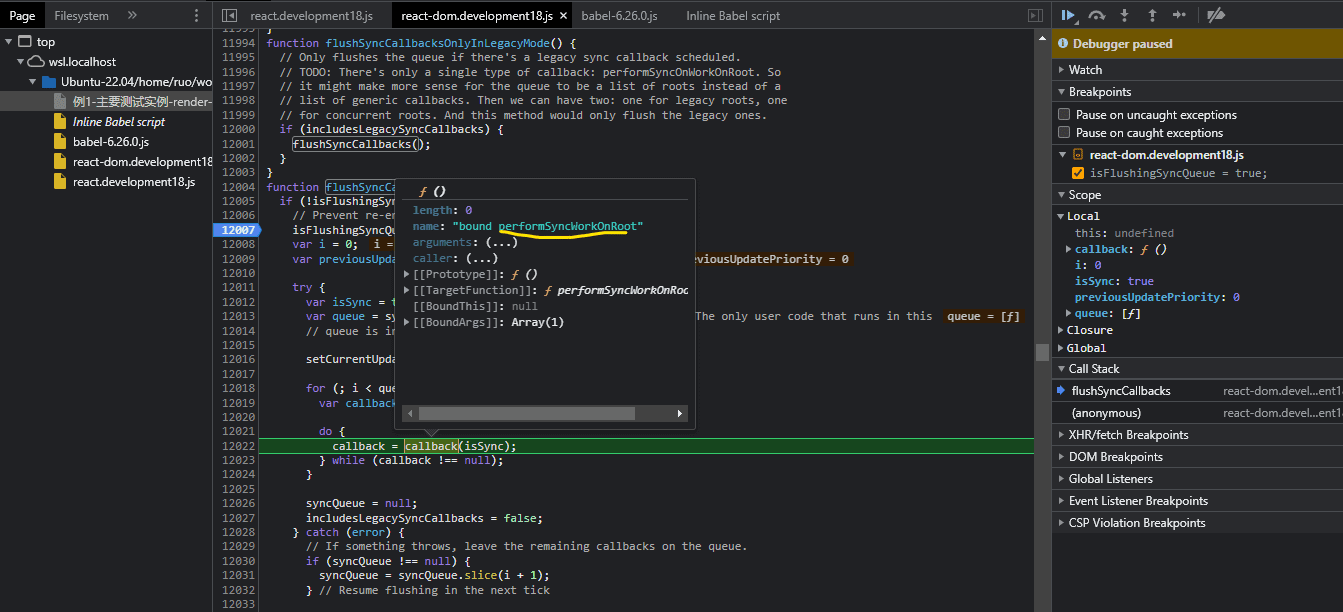
callback = callback(isSync);
function flushSyncCallbacks() {
  if (!isFlushingSyncQueue && syncQueue !== null) {
    // Prevent re-entrance.
    isFlushingSyncQueue = true;
    var i = 0;
    var previousUpdatePriority = getCurrentUpdatePriority();

    try {
      var isSync = true;
      var queue = syncQueue; // TODO: Is this necessary anymore? The only user code that runs in this
      // queue is in the render or commit phases.

      setCurrentUpdatePriority(DiscreteEventPriority);

      for (; i < queue.length; i++) {
        var callback = queue[i];

        do {
          callback = callback(isSync);
        } while (callback !== null);
      }

      syncQueue = null;
      includesLegacySyncCallbacks = false;
    } catch (error) {
      // 省略
  }

  return null;
}
batchedUpdates$1 --> flushSyncCallbacksOnlyInLegacyMode--一系列之后最终会调用ensureRootIsScheduled --> flushSyncCallbacks
function batchedUpdates$1(fn, a) {
  var prevExecutionContext = executionContext;
  executionContext |= BatchedContext;

  try {
    return fn(a);
  } finally {
    executionContext = prevExecutionContext; // If there were legacy sync updates, flush them at the end of the outer
    // most batchedUpdates-like method.

    if (executionContext === NoContext && // Treat `act` as if it's inside `batchedUpdates`, even in legacy mode.
      !(ReactCurrentActQueue$1.isBatchingLegacy)) {
      resetRenderTimer();
      // debugger
      flushSyncCallbacksOnlyInLegacyMode();
    }
  }
}

function flushSyncCallbacksOnlyInLegacyMode() {
  // Only flushes the queue if there's a legacy sync callback scheduled.
  // TODO: There's only a single type of callback: performSyncOnWorkOnRoot. So
  // it might make more sense for the queue to be a list of roots instead of a
  // list of generic callbacks. Then we can have two: one for legacy roots, one
  // for concurrent roots. And this method would only flush the legacy ones.
  if (includesLegacySyncCallbacks) {
    flushSyncCallbacks();
  }
}
一系列调用之后 ensureRootIsScheduled --> flushSyncCallbacks
function ensureRootIsScheduled(root, currentTime) {
  // 省略
  if (newCallbackPriority === SyncLane) {
    // Special case: Sync React callbacks are scheduled on a special
    // internal queue
    if (root.tag === LegacyRoot) {
      if (ReactCurrentActQueue$1.isBatchingLegacy !== null) {
        ReactCurrentActQueue$1.didScheduleLegacyUpdate = true;
      }

      console.log('%c=render阶段准备:ensureRootIsScheduled调用performSyncWorkOnRoot:异步更新legacy模式1==', 'color:red')
      scheduleLegacySyncCallback(performSyncWorkOnRoot.bind(null, root));
    } else {

      console.log('%c=render阶段准备:ensureRootIsScheduled调用performSyncWorkOnRoot:异步更新legacy模式2==', 'color:red')
      scheduleSyncCallback(performSyncWorkOnRoot.bind(null, root));
    }

    {
      // Flush the queue in a microtask.
      if (ReactCurrentActQueue$1.current !== null) {
        // Inside `act`, use our internal `act` queue so that these get flushed
        // at the end of the current scope even when using the sync version
        // of `act`.
        ReactCurrentActQueue$1.current.push(flushSyncCallbacks);
      } else {
        scheduleMicrotask(function () {
          // In Safari, appending an iframe forces microtasks to run.
          // https://github.com/facebook/react/issues/22459
          // We don't support running callbacks in the middle of render
          // or commit so we need to check against that.
          if (executionContext === NoContext) {
            // It's only safe to do this conditionally because we always
            // check for pending work before we exit the task.
            flushSyncCallbacks();
          }
        });
      }
    }

    newCallbackNode = null;
  }
  // 省略
}
更新阶段3-重新执行renderWithHooks,重新挂载hooks:
if (current !== null && current.memoizedState !== null) {
  ReactCurrentDispatcher$1.current = HooksDispatcherOnUpdateInDEV;
}
此时从debugger看到useState:
function (reducer, initialArg, init) {
  currentHookNameInDev = 'useReducer';
  updateHookTypesDev();
  var prevDispatcher = ReactCurrentDispatcher$1.current;
  ReactCurrentDispatcher$1.current = InvalidNestedHooksDispatcherOnUpdateInDEV;

  try {
    return updateReducer(reducer, initialArg, init);
  } finally {
    ReactCurrentDispatcher$1.current = prevDispatcher;
  }
}
function useState(initialState) {
  var dispatcher = resolveDispatcher();
  console.log('=useState=dev=调用dom定义的useState', { initialState, dispatcher })
  const dispatcherRes = dispatcher.useState(initialState)
  console.log('=useState=dev=调用dom定义的useState最后返回值===', dispatcherRes)
  return dispatcherRes;
}
mountWorkInProgressHook作用:
给 memoizedState 链表加节点的逻辑,写过单链表的会比较理解,头节点要特殊处理
- 创建一个 hook
- 若无 hook 链,则创建一个 hook 链;若有,则将新建的 hook 加至末尾
- 将新建的这个 hook 挂载到 workInProgressHook 以及当前 fiber node 的 memoizedState 上
返回 workInProgressHook,也就是这个新建的 hook
function mountWorkInProgressHook() {
  var hook = {
    memoizedState: null,
    baseState: null,
    baseQueue: null,
    queue: null,
    next: null
  };

  if (workInProgressHook === null) {
    // This is the first hook in the list
    console.log('=useState=dom=调用workInProgressHook 1:', { hook, workInProgressHook })
    // 链表中首个hook
    currentlyRenderingFiber$1.memoizedState = workInProgressHook = hook;
  } else {
    // Append to the end of the list
    // 将hook添加到链表末尾
    workInProgressHook = workInProgressHook.next = hook;
    console.log('=useState=dom=调用workInProgressHook 2:', { hook, workInProgressHook })
  }

  return workInProgressHook;
}
setState()-->dispatchSetState() 重点函数在这里触发组件更新
注意: 本示例中虽然同时执行了 2 次 dispatch, 会请求 3 次调度, 由于调度中心的节流优化, 最后只会执行一次渲染
之前 mountState 时,我们返回了一个绑定了 fiber、queue 参数的 dispatchSetState
第一个 setState 在被调用时会立即计算新状态,这是为了 做新旧 state 对比,决定是否更新组件。如果对比发现状态没变,继续计算下一个 setState 的新状态,直到找到为止。如果没找到,就不进行更新。
其后的 setState 则不会计算,等到组件重新 render 再计算。
为对比新旧状态计算出来的状态值,会保存到 update.eagerState,并将 update.hasEagerState 设置为 true,之后更新时通过它来直接拿到计算后的最新值。
dispatchSetState 会拿到对应的 fiber、queue(对应 hook 的 queue)、action(新的状态)。
创建一个 update 空对象;
- 计算出最新状态,放入到 update.egerState。
- 对比新旧状态是否相同(使用 Object.is 对比)。相同就不更新了,结束。不相同,进行后续的操作。
- 将 update 放到 queue.interleaved 或 concurrentQueues 链表上(.new 和 .old 文件的逻辑差得有点多),之后更新阶段会搬到 queue.pending。
- 将当前 fiber 的 lanes 设置为 SyncLane,这样后面的 setState 就不会立刻计算最新状态了,而是在更新阶段才计算。
- 接着是调度更新(scheduleUpdateOnFiber),让调度器进行调度,执行更新操作
enqueueUpdate$1
创建update对象, 其中update.lane代表优先级(可回顾fiber 树构造(基础准备)中的update优先级).
将update对象添加到hook.queue.pending环形链表.
- 环形链表的特征: 为了方便添加新元素和快速拿到队首元素(都是O(1)), 所以pending指针指向了链表中最后一个元素.
- 链表的使用方式可以参考React 算法之链表操作
  function enqueueUpdate$1(fiber, queue, update, lane) {
    if (isInterleavedUpdate(fiber)) {
      var interleaved = queue.interleaved;

      if (interleaved === null) {
        // This is the first update. Create a circular list.
        update.next = update; // At the end of the current render, this queue's interleaved updates will
        // be transferred to the pending queue.

        pushInterleavedQueue(queue);
      } else {
        update.next = interleaved.next;
        interleaved.next = update;
      }

      queue.interleaved = update;
    } else {

      console.log('=useState=app=enqueueUpdate$1将update对象添加到hook.queue.pending队列')
      var pending = queue.pending;

      if (pending === null) {
        // This is the first update. Create a circular list.
        console.log('=useState=app=首个update, 创建一个环形链表')
        update.next = update;
      } else {
        update.next = pending.next;
        pending.next = update;
      }

      queue.pending = update;
    }
  }
继续看updateReducer-->updateWorkInProgressHook
updateWorkInProgressHook函数逻辑简单: 目的是为了让currentHook和workInProgressHook两个指针同时向后移动.
由于renderWithHooks函数设置了workInProgress.memoizedState=null, 所以workInProgressHook初始值必然为null, 只能从currentHook克隆.
而从currentHook克隆而来的newHook.next=null, 进而导致workInProgressHook链表需要完全重建.
可以看到:
- 以双缓冲技术为基础, 将current.memoizedState按照顺序克隆到了workInProgress.memoizedState中.
- Hook经过了一次克隆, 内部的属性(hook.memoizedState等)都没有变动, 所以其状态并不会丢失.
总结: renderWithHooks函数, 把Hook链表挂载到了fiber.memoizedState之上. 利用fiber树内部的双缓冲技术, 实现了Hook从current到workInProgress转移, 进而实现了Hook状态的持久化.
该方法中,currentHook 设置为 current.memoizedState 链表的下一个 hook,拷贝它到 currentlyRenderingFiber.memoizedState 链表上,返回这个 hook。
function updateWorkInProgressHook() {
  // 1. 移动 currentHook 指针
  //(来自 current.memoizedState 链表)
  var nextCurrentHook;
  if (currentHook === null) {
    var current = currentlyRenderingFiber.alternate;
    if (current !== null) {
      nextCurrentHook = current.memoizedState;
    } else {
      nextCurrentHook = null;
    }
  } else {
    nextCurrentHook = currentHook.next;
  }

  // 2. 移动 workInProgressHook 指针
  //(来自 currentlyRenderingFiber.memoizedState 链表)
  var nextWorkInProgressHook;
  if (workInProgressHook === null) {
    nextWorkInProgressHook = currentlyRenderingFiber.memoizedState;
  } else {
    nextWorkInProgressHook = workInProgressHook.next;
  }

  if (nextWorkInProgressHook !== null) {
    // 这种情况为 “渲染时更新逻辑”(在 render 时调用了 setState)
    // 为了更聚焦普通情况,这里不讨论
    workInProgressHook = nextWorkInProgressHook;
    nextWorkInProgressHook = workInProgressHook.next;
    currentHook = nextCurrentHook;
  } else {
    // 3. 渲染时不更新,nextWorkInProgressHook 就一定是 null
    if (nextCurrentHook === null) {
      throw new Error('Rendered more hooks than during the previous render.');
    }

    currentHook = nextCurrentHook;
    var newHook = {
      memoizedState: currentHook.memoizedState,
      baseState: currentHook.baseState,
      baseQueue: currentHook.baseQueue,
      queue: currentHook.queue,
      next: null // next 就不拷贝了
    };

    // 4. 经典单链表末尾加节点写法
    if (workInProgressHook === null) {
      currentlyRenderingFiber.memoizedState = workInProgressHook = newHook;
    } else {
      workInProgressHook = workInProgressHook.next = newHook;
    }
  }

  // 5. 返回拷贝 hook 对象
  return workInProgressHook;
}
拿到拷贝后的hook,可以计算新状态值了。
首先将 hook.queue.pending 队列合并到 currentHook.baseQueue 下。该队列包含了一系列 update 对象(因为可能调用了多次 setState),里面保存有 setState 传入的最新状态值(函数或其他值)。
然后遍历 update 计算出最新状态,保存回 hook,并返回最新状态值和 setState 方法。
关于hooks问题
Hooks为什么不能写在条件语句中?
要保证 React Hooks 的顺序一致。
const [data, setData] = React.useState('改变我')
const [showDiv, setShowDiv] = React.useState(false)
每一个组件都会有一个fiber对象,在fiber中我们主要关注memoizedState这个对象,它就是调用完useState后对应的存储state的对象。
每一个useState都会在当前组件中创建一个hook对象 ,并且这个对象中的next属性始终执行下一个useState的hook对象,这些对象以一种类似链表的形式存在 Fiber.memoizedState 中
调用useState后设置在memoizedState上的对象长这样:(又叫Hook对象)
{
  baseState,
  next,
  baseUpdate,
  queue,
  memoizedState
}
而函数组件就是通过fiber这个数据结构来实现每次render后name address不会被useState重新初始化。 这里面我们最需要关心的是memoizedState和next,memoizedState是用来记录这个useState应该返回的结果的,而next指向的是下一次useState对应的Hook对象,即
hook1  ==>  Fiber.memoizedState
state1 === hook1.memoizedState
hook1.next  ==> hook2
state2  ==> hook2.memoizedState
....
通过上面介绍已经知道各个 hook 在 mount 时会以链表的形式挂到 fiber.memoizedState上。 update 时会进入到 HooksDispatcherOnUpdateInDEV,执行不同 hook 的 updateXxx 方法。
最终会通过 updateWorkInProgressHook方法获取当前 hook 的对象,获取方式就是从当前 fiber.memoizedState上依次获取,遍历的是 mount 阶段创建的链表,故不能改变 hook 的执行顺序,否则会拿错。(updateWorkInProgressHook 也是个通用方法,updateXXX 都是走到这个地方)
函数组件的状态是保存在 fiber.memorizedState 中的。它是一个链表,保存调用 Hook 生成的 hook 对象,这些对象保存着状态值。当更新时,我们每调用一个 Hook,其实就是从 fiber.memorizedState 链表中读取下一个 hook,取出它的状态。
如果顺序不一致了或者数量不一致了,就会导致错误,取出了一个其他 Hook 对应的状态值。
正是因为hooks中是这样存储state的 所以我们只能在hooks的根作用域中使用useState,而不能在条件语句和循环中使用,因为我们不能每次都保证条件或循环语句都会执行:
if (something) {
  const [state1] = useState(1)
}

// or

for (something) {
  const [state2] = useState(2)
}